TV: Capital Case study
Work through the following tasks to build a detailed case study for Capital. This will give you plenty of background information to use in an exam question. Remember, for this CSP the question could be on any of the key concepts: language, industries, audiences or representations.
Reviews and features
Read the following review and feature on Capital:
Guardian review by Sam Wollaston
London Evening Standard: five things you need to know about Capital
1) What positive points does the review pick out about Capital? What criticisms are made - either of the TV drama or the original novel?
Good points that were viewed were that there was that the cast was brilliant. They mentioned Toby Jones who played Roger, saying that his character was predictable with a weary heart character. They also mentioned the idea of using star power from the film Harry Potter, Gemma Jones which could allow Capital to gain more audiences from Harry Potter loyal fans and supporters. Furthermore, the narrative was based on an acclaimed novel by Lanchester with the same name. It could also ring to Londoners who has experienced the same situation with economic struggles.
2) What references can you find in the reviews and feature to the idea Capital is a 'state-of-the-nation' drama? How does it capture modern-day London?
2) What references can you find in the reviews and feature to the idea Capital is a 'state-of-the-nation' drama? How does it capture modern-day London?
The references is that it is a state of the nation drama where it featured the financial and economic struggles of the Londoners back in 2008. Capital focused on the genre of being more down to earth where there were some scenes and narratives that would allow the audiences to personally relate to. Some of these are when Roger didn't get his bonus even if he worked hard for it, there were some family problem with Petunia and her daughter, and the idea of discrimination towards the Pakistanis.
Trailer analysis
Watch the trailer for Capital:
1) How does the drama use camerawork to capture London life?
The drama uses camerawork to capture the London life by using a drone shot, focusing on the London street and cities. They also used a range of different handheld camera work to showcase the authenticity of the situations of the people who lives in London.
2) How does the trailer introduce the different narrative strands suggesting tension or enigma in the 40-second running time?
The trailer introduced different narrative strands suggesting enigma codes by showcasing the ensemble cast, showing the ensemble cast kind of gives the idea that there would be a range of different perspectives throughout the drama. Also, they showed how each residents gets the postcard "WE WANT WHAT YOU HAVE" which kind of gives that enigma codes as to how each character are going to deal with it and how it will affect them.
2) How does the trailer introduce the different narrative strands suggesting tension or enigma in the 40-second running time?
The trailer introduced different narrative strands suggesting enigma codes by showcasing the ensemble cast, showing the ensemble cast kind of gives the idea that there would be a range of different perspectives throughout the drama. Also, they showed how each residents gets the postcard "WE WANT WHAT YOU HAVE" which kind of gives that enigma codes as to how each character are going to deal with it and how it will affect them.
Capital in Media Magazine
Issue 83 of Media Magazine has a feature exploring Capital as a media product. Read ‘We Want What You Have’ in MM83 (p10). You'll find our Media Magazine archive here - remember you'll need your Greenford Google login to access. Answer the following questions:
1) What does the article suggest about the 'state of the nation' genre and how Capital is an example of this?
The state of the nation genre tries to represent an entire country at a particular moment in time. As such, they involve multiple storylines and a large cast. This genre tries to cover aspects of politics, crime and policing, journalism and finance. Capital is an example of this because Capital follows in its footsteps. Despite being restricted to four episodes, it has a large ensemble cast and features multiple storylines pertinent to its 2007/8 setting. It focuses on
characters with links to Pepys Road being a great 17th century state-of-the nation London
diarist.
2) What does the article suggest regarding the setting of Capital?
Capital centred the action on a single street then helps bring some focus to the narrative. They focused the main narrative on Pepy's road, where all houses on that road gets a postcard that says "WE WANT WHAT YOU HAVE". The street became iconic as it was from a diarist from the 17th century being known as a state of the nation.
3) What are the major themes in Capital and what does the article suggest regarding the impact of money on communities?
The major themes in Capital are the idea that the action focuses on one street, bringing cohesion to the narrative. It also focused on the idea of increased pricing of houses where only the top earners can afford to buy it.
4) What different representations in Capital are discussed in the article?
It is set in the build up to the banking crash of 2008 and in some ways acts as a satire on the impact of capital – money – on everyday lives, suggesting that the banks are the bad guys. They represented the idea of good versus bad, rich versus poor and industrious versus feckless. These ideas link to Levi-strauss's binary opposition.
5) What does the final section of the article suggest regarding genre and overall message of the drama?
The genre shows that it is a state of the nation genre but however they also were able to feature a sense of crime genre. This is where at the very first scene in episode one, cold opehing, showed a shadowy hooded figure, where the scene was in a handheld shot, reinforcing the idea of enigma codes. The genre focused on the politics narrative where they tried to expose what the bankers were trying to do at that time as they were difficult to track. Also, the banker were seen as criminals as the land prices had increased.
Capital Media Factsheet
Use our Media Factsheet archive on the M: drive Media Shared (M:\Resources\A Level\Media Factsheets) or on Google Drive here (you'll need your Greenford Google login) to find Media Factsheet #194 on Capital (BBC TV Drama).
Read the whole of Factsheet and answer the following questions:
1) What does the factsheet say about the characters on the first page?
The factsheet suggests that the characters (residents) were used to explore a mulit-strand narrative. The different characters were used to demonstrate the state of the nation genre such as through Petunia and Roger and Arabella. The interactions between the characters reflect the tensions between different cultures and costume is used to quickly communicate the different character roles.
2) Focusing on the industrial contexts, how does Capital help the BBC meet its obligations as a public service broadcaster?
The Capital help the BBC to meet its obligations as PSB by focusing on how the BBC seek to inform, entertain and educate. The Capital helped to gain this by allowing audiences to gain a sense of escapism as it is in a series where audiences can peronally relate and identify themselves. They might be able to see themselves in the character's persepctive, a sense of identification. Also, the Capital provides a diverse narrative, featuring different race and ethnicity in the series, where audiences might relate and for the Capital and the BBC to gain more audiences.
3) What do we learn about the ownership structure for production company Kudos?
The ownership structure was horizontally integrated company. The different companies involved in the production of Capital were Endemol Shine UK, which is the conglomerate. Where Endemol Shine UK is owned by an equal share between Apollo Global Management and 21st Century Fox (owned by Murdoch family).
4) How can David Hesmondhalgh's ideas in The Cultural Industries be linked to Capital and Kudos?
Hesmondhalgh's ideas in the Cultural Industries is linked to Capital and Kudos as they used a horizontal integration so that they can maximise their profit and audiences as well as being able to spread risk.
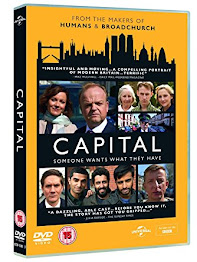
Capital meets the genre conventions of crime as they used a lot of narrative enigmas such as the postcards “WE WANT WHAT YOU HAVE” as well as showing a shadowy hooded figure taking picture every night. Also, the idea that it got more serious when the anonymous person started to deliver dead animals to the houses. For social realism they were able to represent the UK streets as well as the social issues that happened in 2008 where they kind of sees the bank as the antagonist. Also, they were able to create an authentic narrative with the characters being diverse as well as the discriminations that other people in the UK might be experiencing.
6) How does the factsheet analyse the DVD packaging and what this communicates to the audience?
They mentioned the use of the silhouette skyline of London, highlighting that the TV drama is set in London and also featuring London. Also, the idea that all the characters are laid out on the front cover connotes the crime drama as well as the use of medium close up shots. Furthermore, they mentioned the colour scheme where they tried to draw the audience away from the typical stereotypes of a crimes drama but uses yellow as for the audience to focus on the representation of state of the nation.
7) Look at page 5 of the factsheet. Choose one of the audience theories in the table and apply it to Capital.
Blumler & Katz’s Uses and Gratification could apply well to Capital as the idea of diversification could allow the audiences to gain a sense of escapism as the genre is about social realism and it is a series where they might be interested in. Linking to this, the audiences might be interested due to a connection between them and the characters they might see themselves as the character where they might personally identify themselves with. Also, they might feel sympathy towards the characters due to the episodes highlighting their struggles and the increase economically. They might also experience a surveillance, where audiences might be informed that on how to deal with problems and what they should and shouldn’t do.
8) What does the factsheet suggest regarding binary oppositions in Capital?
They highlighted difference and inequality where there’s a financial inequality between Roger and Arabella.
Representations: close-textual analysis
Capital offers a range of fascinating representations - from London and asylum seekers to capitalism and inequality. You need to be able to confidently discuss these issues in the context of 2015 London - with reference to key scenes from episode 1. Representations include: London, family, gender, ethnicity, religion, immigration, asylum, inequality, wealth, capitalism, aging and more.
These are our notes from this year analysing the episode in class. There are also these notes from a previous year analysing the clips in case this is useful. Use this to help with this element of the case study. You'll need your Greenford Google login to access the document.
1) Write an analysis of the representations in each of the key scenes from episode 1 we studied in the lesson:
Scene 1: opening sequence 00:30 – 4.44
1) Write an analysis of the representations in each of the key scenes from episode 1 we studied in the lesson:
Scene 1: opening sequence 00:30 – 4.44
Used London as the setting to authenticate the narrative in London, especially highlighting the increase of housing prices throughout the year, reflecting on what happened back in 2008. It also shows the diversity of London's society and how it has gotten more diverse in the modern age. Also, there's a montage sequence to highlight the representation of the lower-middle-class life.
Scene 2: work in the City 6.28 – 8.10
Drone shot showing the centre of London which emphasises power and dominance. In the scene at the workplace, it doesn't show any female character, connoting that the bank job is dominated by men.
Scene 3: “Which of those isn’t absolutely essential?” 14.00 – 15.35
There were traditional society roles that the scene reinforces. This is where it shows that Roger was the 'breadwinner' where he does all the work and provides profit for the family. Whereas, Arabella as the house wife, where she takes care of their children and does the childrearing.
Scene 4: asylum 18.03 – 19.42 AND 31.10 – 32.40
In the scene it shows a black female lawyer, connoting the idea of modern society in Britain that it is becoming more diverse and that there's more opportunities for everyone. Also, there are dominant ideologies where Quentina was highlighted and presented as positive despite working illegally. In addition, there was a handheld shot, connoting the hard work, chaotic and problems that Quentina is experiencing as well as what she's feeling at that time.
Scene 5: “What use is 30 grand?” 36.40 – 39.00
Another drone shot of the London city, reinforcing again the idea that London is powerful. In addition, the use of time-lapse shows Roger's disoriented situation that may seem like everything's blurry for him due to his problems.
Scene 6: life at the corner shop 40.10 – 42.55
There's a disconnection between the working class and middle class as Arabella never really goes to the shop but she went to the shop only once. Also, there's a reinforcement of South Asian stereotypes as it shows how the family were talking to their grandmother on call during dinner which could also reinforce the idea of their family having a close-knit bonding.
You can choose which aspects to focus on for each scene: e.g. London, family, gender, ethnicity, religion, immigration, asylum, inequality, wealth, aging etc. Feel free to use bullet points for each scene - a summary of your notes is fine.
2) How does Capital use stereotypes? Do the characters and issues represented in Capital reinforce or subvert the stereotypes we typically see in the media?
Capital uses stereotypes by using an ensemble cast that has different ethnicity and different roles that allows the narrative to portray different stereotypes. The characters and issues represented in Capital could reinforce some stereotypes we typically see in the media for example, Mulvey's male gaze, women are still seen as objectified and sexualised. However, it could also be subverted due to the modern age being more open to these idea and might actually respect the different stereotypes in the society.
Industries and production context
Capital was produced by independent production company Kudos for the BBC. Look at the Kudos website and also read the Kudos Wikipedia page.
1) Who is the parent company for Kudos? What changes of ownership have there been for Kudos? This is an example of conglomerate ownership.
Capital was produced by independent production company Kudos for the BBC. Look at the Kudos website and also read the Kudos Wikipedia page.
1) Who is the parent company for Kudos? What changes of ownership have there been for Kudos? This is an example of conglomerate ownership.
The parent company for Kudos is Endemol Shine Group also was owned by Banijay ownership (2020).
2) Watch the showreel on the Kudos website. What other TV dramas have Kudos produced and for which channels? What awards have they won?
2) Watch the showreel on the Kudos website. What other TV dramas have Kudos produced and for which channels? What awards have they won?
They have produced SAS: Rogue Heroes on BBC One and Utopia on Channel 4 and Amazon Prime Video.
3) How does Capital help the BBC to fulfil its remit as a public service broadcaster? You may want to look back at our work on public service broadcasting last term.
The Capital was able to help the BBC to fulfil its remit as PSB as they were able to produce a TV drama that portrays the BBC's message, to inform, educate and entertain.


Comments
Post a Comment